Military Mech - The Game Assembly
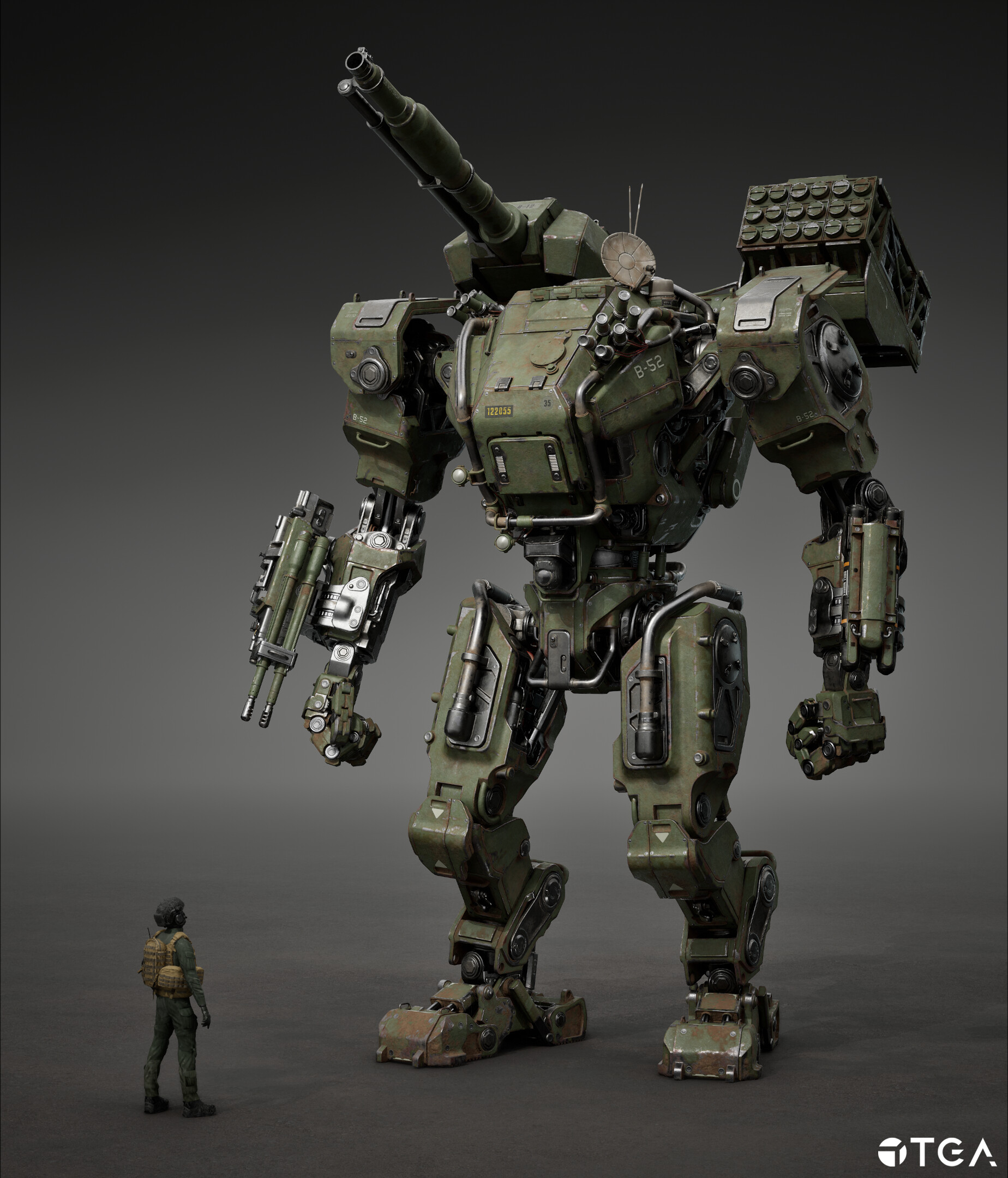
This is one of my portfolio pieces from The Game Assembly: a Military Mech set in an alternate near-future. I've wanted to create a large mechanical mech for a long time and now had the perfect time for it. My goal with this project was to create a real-time model in Unreal Engine 5 and use a workflow that felt suitable for such a big asset.
Breakdown at the bottom of the post.


I primarily worked with booleans and subD modeling when blocking and trying shapes for the silhouette, which later lead to a clean up and parts of the model. Throughout the entire project, many parts where remade entirely, several times.

602152 triangles, fully equipped with ammunition and rockets.

For the baked parts, I stacked all UVs possible and used one 4K normal atlas, across the model. Some unique assets were also textured separately on a 2k texture set.

Baked parts sits on UV space 0-1 and the Midpoly sits outside UV space 0-1. By applying a vertexcolor to the baked parts in blender, I could control what parts are using the normal map. This way I could use the same material for baked and nonbaked meshes.

I textured the model using tiling materials and RGB masks with a Texel density of 1024 TD/m and made all the materials in Substance Painter.

I made a second UV channel on the model, and created a blurry RGB mask in Substance Painter. The mask controls where I blend between my materials in the shader. I used a 256 reveal mask to enhance the RGB mask.

I created two decal sheets: a 512 texture with bolts and screws baked from high-poly meshes onto a plane, and a 1024 texture with details made in Substance Painter. Everything was then uvmapped to floaters and place on the model. Alphas not by me.
I used roughly the same setup for each channel in the shader, which were mainly adjustments to the RGB mask and material blending, as well as some controls for color and roughness overlays to add variation.
Part 1 - I rigged the model in blender for easier posing, and to showcase some functionality.
Part 2 - I rigged the model in blender for easier posing, and to showcase some functionality.